
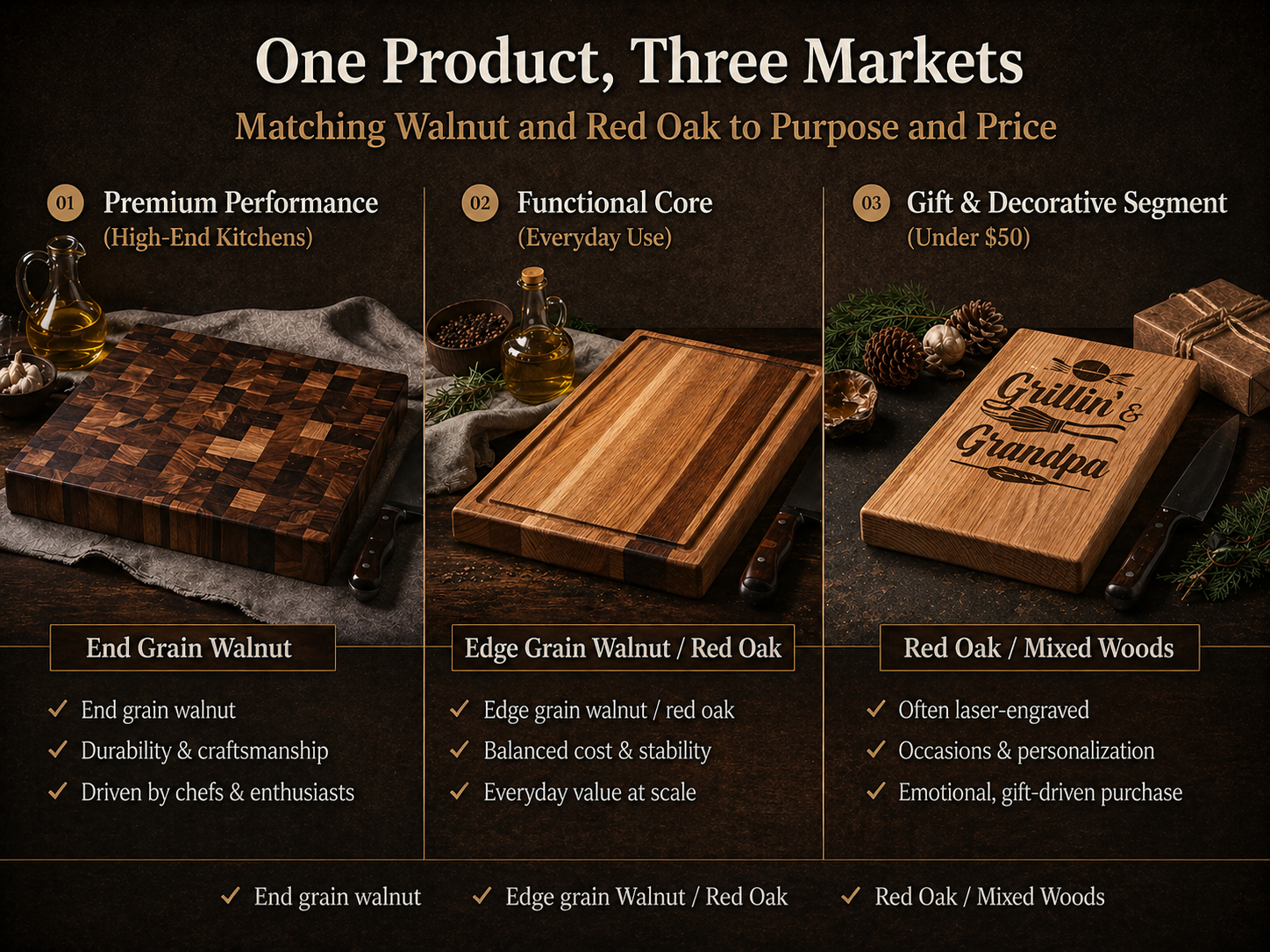
In the wooden kitchenware industry, one question comes up again and again:
“Why do wooden cutting boards that look similar vary so much in price?”
At first glance, the difference may seem to come down to material cost. But in reality, pricing is driven by a much broader set of factors — including wood structure, intended usage, customer expectations, branding, and channel strategy.
After years of working with international brands and retailers, we’ve identified a clear and practical framework:
👉 One Product, Three Markets
Using a single category — wooden cutting boards — as an example, we can break the market into three distinct segments, each with its own logic and strategy.
1.Premium Performance Segment
End Grain Walnut Cutting Boards
At the high end of the market, we find end grain walnut cutting boards — a product category strongly associated with professional kitchens and premium brands.
What is End Grain Construction?
End grain boards are made by arranging wood fibers vertically, so the cutting surface exposes the end fibers rather than the side grain.
This structure offers two major advantages:
Self-healing surface: Wood fibers naturally recover after knife cuts
Knife-friendly: Reduces wear on knife edges
Why Walnut?
Walnut is widely recognized in Western markets as a premium hardwood due to:
Excellent dimensional stability
Rich, dark grain with strong visual appeal
Balanced hardness for both durability and usability
Target Customers
Professional chefs
Cooking enthusiasts
High-end kitchen users
These customers prioritize:
Performance
Longevity
Brand and aesthetic value
Key Product Characteristics
Thick and heavy construction (often 4cm+)
Handcrafted or semi-handcrafted production
Premium price range (typically $80–$200+)
👉 At this level, customers are not just buying a cutting board — they are investing in performance, craftsmanship, and identity.
2.Functional Core Segment
Edge Grain Walnut / Red Oak Cutting Boards
This is the largest and most competitive segment in the market.
What is Edge Grain Construction?
Edge grain boards are made by placing wood strips side by side, so the cutting surface shows the long grain (side grain).
Compared to end grain boards:
More cost-efficient
Easier to manufacture at scale
Still offers solid durability
Why Red Oak Matters
Red oak is widely used in this segment because:
Lower raw material cost
Stable supply for large-volume production
Good structural strength
However:
It has a more open grain structure
Requires proper finishing for food safety and longevity
Core Market Logic
👉 Balanced performance at an accessible price point
This segment dominates:
Amazon marketplaces
Retail chains and supermarkets
Private label brands
Key Product Characteristics
Strong price-performance ratio
Consistent quality at scale
Wide range of sizes and SKUs
👉 This segment is fundamentally about volume, efficiency, and market competitiveness.
3.Gift & Decorative Segment
Red Oak / Mixed Wood Cutting Boards
Often underestimated, this segment offers strong opportunities — especially in e-commerce and seasonal sales.
The Core Value is Not Function — It’s Emotion
Unlike the other segments, these boards are not primarily used for heavy kitchen tasks.
Instead, they are designed for:
👉 Emotional value and personalization
Examples include:
Laser-engraved designs (e.g., “Grillin’ & Grandpa”)
Holiday gifts (Christmas, Father’s Day, weddings)
Custom branding or messages
Why Use Red Oak or Mixed Woods?
Lower material cost
Easier processing
Ideal for laser engraving and customization
Typical Sales Channels
Etsy and personalized gift platforms
Shopify/DTC brands
Corporate gifting programs
Key Product Characteristics
Affordable price range (typically under $50)
Design-driven and highly customizable
Lightweight and flexible production
👉 This segment is driven by design, storytelling, and emotional purchasing behavior.
4.The Business Logic Behind the Three Segments
From a supply chain and product strategy perspective, these are not just three products — they represent three fundamentally different business models.
Segment Core Driver Key Focus
Premium Performance Material & craftsmanship
Core Cost efficiency Scale & consistency
Gift Emotional appeal Design & customization
5.What This Means for Brands
For brands looking to build or expand their wooden kitchenware line, this framework offers clear direction:
Build a Complete Product Portfolio
Instead of relying on a single product type:
Premium products build brand image
Core products generate stable revenue
Gift products attract new customers and seasonal sales
Align Products with Sales Channels
Premium → Specialty retail / high-end online stores
Core → Amazon / mass retail
Gift → Etsy / direct-to-consumer platforms
Avoid One-Product-Fits-All Strategy
Trying to serve all markets with one product often leads to:
Misaligned pricing
Weak positioning
Reduced competitiveness
6.What This Means for Buyers and Sourcing Teams
From a sourcing perspective, this segmentation is even more critical.
Material Selection Directly Impacts Profitability
Using walnut for gift items → unnecessarily high cost
Using red oak for premium positioning → weak brand perception
Different Products Require Different Factories
End grain → requires advanced craftsmanship
Edge grain → suited for scale manufacturing
Gift boards → require flexibility and engraving capability
MOQ and Pricing Strategy Must Match the Segment
Premium → lower volume, higher margin
Core → large volume, tighter margins
Gift → multiple SKUs, flexible production
7.Our Experience in the Wooden Products Industry
With over a decade of experience in wooden product manufacturing and export, we’ve observed one consistent pattern:
👉 Successful brands don’t rely on a single product — they build structured product lines.
They typically:
Use premium products to establish credibility
Use core products to drive volume
Use gift products to expand reach and capture seasonal demand
8.Final Thoughts: It’s Not Just a Cutting Board
Wooden products may seem simple, but in reality:
👉 They are highly strategy-driven products
The same piece of wood can sell for:
$20
or $200+
The difference lies in:
Market positioning
Target audience
Product story
If you are developing a wooden product line or looking to optimize your current assortment, a clear segmentation strategy can significantly improve both sales performance and brand positioning.
We work closely with brands and retailers to develop tailored wooden product solutions based on their target market and channel strategy.
If you’re interested, feel free to reach out — we’d be happy to explore how we can support your next product line.